Dieses Tool auf Deutsch: Lebensrad
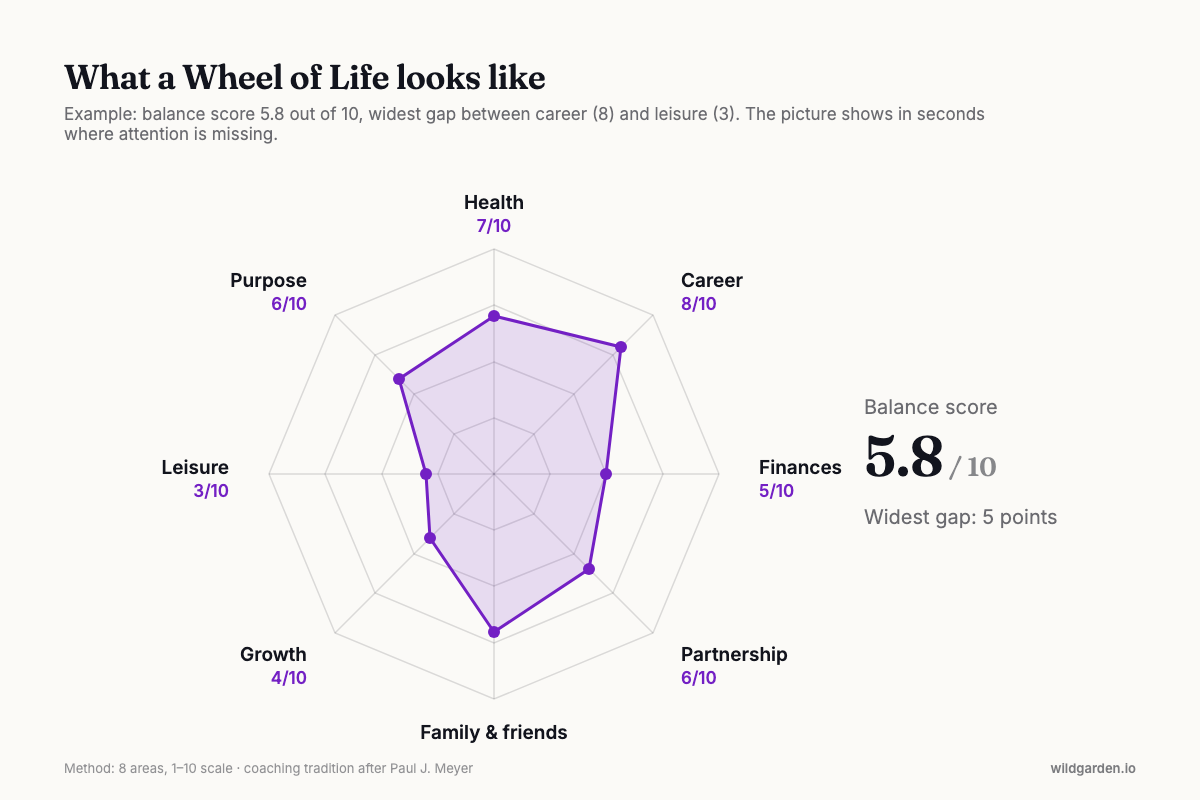
The Wheel of Life shows you in two minutes how balanced your life actually is. You rate eight areas from 1 to 10 and get an instant picture: your balance score, your widest gap, and the one area that deserves attention first. No sign-up, no email wall, no gated PDF.
Why bother with a wheel?
Most people optimize the area that shouts loudest, not the one that is emptiest. Work eats leisure, money worries eat sleep, and two years later the exhaustion feels mysterious. The wheel forces you to look at all eight areas at once. That is the entire trick, and it works.
Two numbers summarize the picture. The balance score is the average of your eight ratings. The gap is the distance between your strongest and weakest area, and it is usually the number that matters more: a life of steady sevens feels rounder than one made of tens and threes.
How to read your result
Below 5 in any area means you are running a deficit there. Between 5 and 7 is everyday territory, fine but without tailwind. From 8 up, the area carries you. A gap of 4 or more points between two areas is a strong candidate for where change wants to happen.
One instruction matters: rate how satisfied you are, not how impressive the area looks from outside. A 9 in career built on 60-hour weeks that hollow you out is not a 9.
Where the method comes from, and what it can and cannot do
The Wheel of Life comes from the coaching tradition of the 1960s, developed by Paul J. Meyer. It is not a validated psychometric test and does not measure personality; it structures a self-assessment. We say that plainly because many sites do not. As a reflection tool it has earned its keep for decades anyway: not because it measures, but because it makes things visible.
The math is deliberately simple: the score is the mean of your eight ratings, rounded half-up to one decimal. The gap is maximum minus minimum. No weighting, no hidden magic.
What to do with your result
Pick your lowest area and plan one small step for this week. Not three areas, not five habits. One. Redo the wheel every four to eight weeks; the change between snapshots tells you more than any single one. Many people also use it as a ritual every January and July.
The scale at a glance
| Rating | Reading |
|---|---|
| 1 to 4 | Deficit: you are paying for this area right now |
| 5 to 7 | Everyday: fine, but no tailwind |
| 8 to 10 | Resource: this area carries you |
| Gap of 4+ points | Where change wants to happen |
Wheel of life template: fill it in here or draw your own
Most people searching for a wheel of life template want a printable PDF. The wheel above replaces exactly that: rate eight life areas from 1 to 10, see the result instantly, download nothing, hand over no email address.
For workshops, coaching or a journal, the paper version still works: draw a circle, split it into eight equal segments with eight spokes, and label each spoke from 1 on the inside to 10 at the rim. Mark one point per area and connect the points. Read the resulting shape the way the result is read above: even and far out means balanced, deep dents point to the widest gap.
Frequently asked questions
What are the eight areas of the Wheel of Life?
The usual set: health, career, finances, partnership, family and friends, personal growth, leisure, and purpose. Rename them mentally if your life has different anchors; the structure does the work either way.
What is a good balance score?
There is no target number, and that is the point. A 6.5 with a small gap is sturdier than a 7.5 built from tens and threes. Compare yourself with your last wheel, not with anyone else.
How often should I do the wheel?
Every four to eight weeks is a good rhythm. More often and you measure daily mood instead of development; less often and you lose the thread.
Is the Wheel of Life scientifically validated?
No, and we will not pretend otherwise. It is a coaching tool for self-reflection, not a psychological instrument. It does not replace therapy or diagnostics.
Why free, with no email wall for a PDF?
Because a reflection tool has no business collecting anything about you. Your ratings never leave your browser. Want to keep the result? Take a screenshot.
Changelog
Version 1.0.0, August 23, 2026: first release. All sources retrieved August 23, 2026. Verification runs and source hashes live in the project ledger.
Sources and method
Our own implementation of the Wheel of Life from the coaching tradition of Paul J. Meyer (Success Motivation Institute, 1960s). Scoring: mean and range of the eight ratings, disclosed in full above.
Published August 24, 2026 · Last updated September 10, 2026 · Wild Garden Editorial Team · Last verified September 10, 2026 · Tested against an independent reference implementation: 69,706 of 69,706 cases pass (the first 2026 run failed the reference, not the tool; all runs in the verification record). Our editorial standards · Spotted an error? redaktion@wildgarden.io
This tool is self-reflection, not diagnostics. If things feel persistently heavy, the 988 Suicide and Crisis Lifeline is available around the clock in the US: call or text 988.
More from the garden
All calculators live under Tools. If health came out lowest, the TDEE Calculator hands you the most important number to start with. If finances did, the Net Worth Percentile gives you an honest read on where you stand. And once you know where to start: the habit calculator shows how long new routines really take. And when calm is the area to work on: the breathing exercise timer runs on open math.